How to get better product use data? Track it in environmental monitoring social networks.
by Inês Sousa on November 3, 2008 05:23 PM

My last post asked a few questions about how new product design approaches could promote sustainable consumption. Along the same lines, let’s explore how product designers might collect better and more data on product use to inform the ecodesign process. Potential solutions present some quite promising ideas for product designers. Think of it as a wildlife-tagging program for products monitored in social networks.

Here’s how I frame the issue:

What are appropriate strategies and tools that could help design teams create products supporting collaborative environmental monitoring to inform ecodesign and motivate sustainable behavior? How can collected data be timely incorporated into product design such that it can inform both designers and consumers in a participatory ecodesign setting?

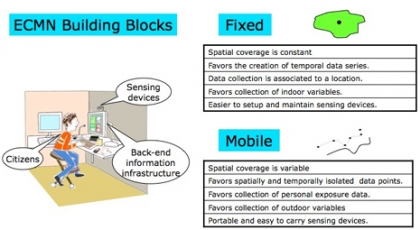
Cristina Gouveia and colleagues1, 2 explored the role of the public in environmental monitoring beyond isolated initiatives and official environmental monitoring networks. Information and communication technologies (ICT) can empower citizens to develop environmental collaborative monitoring networks (ECMN) with environmental data collected by volunteers and community-building mechanisms promoting behavioral changes.

The building blocks of ECMN are motivated citizens, sensing devices and back-end information infrastructure. Individuals can use their households, offices or schools as fixed stations for environmental monitoring; they can also be mobile sensors using mobile communication and computing to collect and communicate in situ and real-time environmental data. Ultimately, ECMN promote collaboration among the different stakeholders – from the general citizen to environmental experts and decision-makers.

The Sustainability Information Lab at UC Berkeley is also conducting interesting research projects exploring how information about the environmental, social, and health effects of products and companies is provided to consumers in the marketplace. For example, they are assessing and recommending new information infrastructure and institutional designs that can make more credible and relevant information available to the public, companies, governments, and consumers. New technologies, such as RFID chips embedded inside products, may support much more effective flows of product and environmental information along supply chains.

So, what if product designers and consumers collaborate in ECMN-driven social networks? What if environmental information systems and infrastructures of companies are designed to go beyond their supply chain and monitor the environmental performance of their products during use?

For example, in a participatory ecodesign monitoring system and social network, consumers would provide tracking data with sensors, such as GPS and RFID chips3 or other smart sensors embedded in the products they use and discard. These data would inform the design team in real time about product environmental performance from real use, while potentially raising consumers’ environmental awareness concerning their use of products.

Collected data could also be used in portals such as PEMS Web (Public Environmental Modeling and Simulation Web). PEMS provides the general public with access to a web of computer-based, environmental models and simulations shared by experts and researchers from around the world. The simulations provided by PEMS Web could further inspire new product design strategies and consumer’s sustainable behavior.

What is fascinating about these approaches is not just that they have the potential to provide volumes of product-use data and simulations relatively easily, and thus better inform product designers to devise appropriate ecodesign strategies. They also provide yet another way to move towards sustainable consumption by collaboratively mobilizing public awareness and promoting informed consumption and behavior change.


References

  1. Gouveia, C, Fonseca, A., Câmara, A., Ferreira, F. (2004). Promoting the Use of Environmental Data Collected by Concerned Citizens through Information and Communication Technologies. Journal of Environmental Management 71 (2): 135-154.
  2. Gouveia, Cristina (2008). Environmental Collaborative Monitoring: Linking Senses. Ph.D. Thesis. New University of Lisbon, Portugal.
  3. Lee, J.A. & Thomas, V.M. (2004). GPS and Radio Tracking of End-of-Life Products. In Proceedings of the 2004 IEEE International Symposium on Electronics and the Environment, pp. 312-309.

Image:

  • source: ECMN  | credit: Cristina Gouveia

Comments

Post new comment

The content of this field is kept private and will not be shown publicly.
  • Web page addresses and e-mail addresses turn into links automatically.
  • Lines and paragraphs break automatically.

More information about formatting options

Top of mind

  • Technology and The Environment Sessions at the International Consumer Electronics Show hone in on some of the most important steps forward the CE industry has taken, from Energy Star advances to best practices in recycling and energy consumption. Las Vegas, Nevada, January 8-11, 2009

  •  Eco-designers are invited to submit their consumer electronics innovations for prizes and recognition at the Greener Gadget Conference, where industry luminaries meet to discuss the future of CE sustainability. Entry deadline is January 15, 2009. Conference will be held in New York, NY, February 27, 2009.

  • Americana International combines a conference program, trade show and international business matchmaking forum among environmental industries that include municipal and industrial wastewater, soil remediation and groundwater, ecoengineering, bioeconomy and life cycle analysis. Montreal, Canada, March 17-19, 2009.

  • Ethical Sourcing Forum North America 2009 spotlights sustainable business practices currently transforming global supply chains. Topics include sustainable purchasing, food, agriculture, and beverage sector, environmental measurement and monitoring and supply chain rating/reporting. New York City, March 26-27, 2009.

  • The Green Business Certification Workshop provides seminars on green marketing, developing partnerships and greening your operations. Participants receive Clean Air Green Business Certification from the Clean Air Institute. Ft. Collins, CO, January 30 – February 1, 2009.

  • The Green Travel Summit convenes a forum for corporate travel, meetings and incentive professionals, and progressive travel service providers to discuss the risks and rewards of building a sustainable travel and meetings strategy. Newport, CA, March 22, 2009.

  • The 8th International Electronics Recycling Congress offers a platform for government, business and academic participants to discuss how manufacturers can close the recycling loop. Salzburg, Austria, January 21-23, 2009.

  • 2009 Good Jobs, Green Jobs National Conference will forge an agenda for creating jobs and new technologies to reduce global warming, increase our energy independence and promote a healthful environment. This year's conference will also include a Green Jobs Expo. Washington DC, February 4, 2009.

  • Best marketing for sustainable energy will be awarded at the World Sustainable Energy Days 2009 conference, 25 – 27 February 2009, Wels/Upper Austria. Deadline for submission is 15 January 2009.

  • World Critical Resources Summit brings together 300 world leaders to facilitate solutions to sustain, expand, and protect the world's critical resources, including shelter, water, food, energy, medicine, and children. January 5th, 2009, New York.

  • A Greener Europe. The European Commission proposed a legislative package last month aimed at improving the environmental performance and energy efficiency of products and stimulating their market uptake.

  • Greener Chrysler Plant Expansion. From recycled paint sludge to replanted prairie grass, Chrysler incorporates environmentally friendly features in a Detroit plant.

  • High Tech, Low Marks. Global executives are concerned about climate change, but they aren't taking action in the supply chain that could address the issue and reduce costs, according to a McKinsey & Co report.

  • The Designer’s Field Guide to Sustainability, by our blog contributor Travis Lee, offers practical suggestions for incorporating sustainable thinking in everyday design.

  • Simplicity Saves the Day: BNN speaks with Paul Polak, founder, International Development Enterprises (IDE), a new for-profit company D-Rev, and author of Out of Poverty.

  • Carbon dioxide produced by the high-tech industry is expected to triple by 2020. Here’s how companies like Google, Cisco, HP, Sun, Intel and Microsoft are working to reduce global emissions.

  • A growing movement among designers, engineers, students and professors and architects is exploring designing and developing low-cost solutions for the 'other 90%'.

  • A new milk jug is green in almost every way – except consumers don’t like it. Here's how the manufacturer is educating consumers to change their perception.

Creative Commons License