Insights from the Green Event
by Grant Kristofek on October 24, 2008 04:33 PM

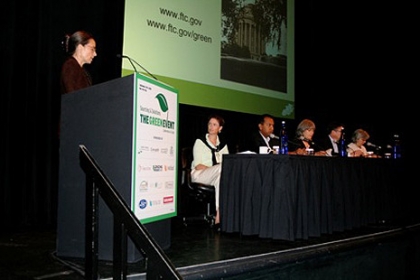
The ‘Green Stamps‘ panel helps attendees learn about what is available in the market to support their green claims.

I was recently on Broadway — not in the latest production of West Side Story — but at the Hudson Theatre for The Green Event. The two-day conference brought together textile industry stakeholders — suppliers, buyers, designers, and regulators — to share ideas for developing eco-conscious practices across the board.

I had an opportunity to participate on the ’Creating Green‘ retail panel alongside Marks & Spencer’s veteran cotton expert, Graham Burden. I shared Continuum’s insights about the consumer perspective on sustainability, sparking a conversation about the need to consider the demand-side of the sustainability equation. My talk followed an excellent keynote by Andrew Winston, author of Green to Gold and founder of Winston Eco-Strategies. Mr. Winston spoke passionately about the business case for sustainability, citing numerous examples of companies that had achieved true competitive advantage by identifying upside opportunities or eliminating downside risks in this space.

Ian Yolles, a co-founder of the novel sustainable clothier, Nau, was one of the most compelling voices at the event. He explained how he and a few friends (ex-execs from Nike and Patagonia)  got together in 2005 to create a new form of ’business activism‘ by founding a company on the ideals of sustainability and social responsibility. Their corporate bylaws turned the traditional clothing retail model on its head in a number of ways, including: mandating the use of more sustainable materials and processes (for example, recycled PET soda bottles become recyclable polyester garments), providing a 5% donation of sales to non-profit philanthropy (to be specified by customers at POP) and selling directly to customers through an assortment of low-impact retail outlets (both the internet and their novel store-meets-internet ’webfronts‘).

In 2007, Nau’s aggressive strategy met an adverse twist of financial fortune, forcing the company to close its doors after just one year in business. However, Ian explained that the abiding support of their nascent customer base (via blogs, emails, letters, and phone calls) helped Nau quickly find a partner who recognized the intrinsic value of their brand. Nau officially re-opened for business on October 15, 2008.

The event rounded out its message of pragmatic optimism with informative presentations and panel discussions featuring novel eco-friendly materials from suppliers such as Dupont, Lenzing,  and Unifi. Regulators and policymakers from the Federal Trade Commission, Carbon Trust, the Organic Exchange, Oeko-Tex, and others were also on hand to help attendees understand how to certify their products and make honest claims about them to their consumers.

All in all, the conference was a great opportunity to share success stories and inspire industry-wide collaboration to further the sustainability effort.

Image credit: Formula4Media

Comments

Post new comment

The content of this field is kept private and will not be shown publicly.
  • Web page addresses and e-mail addresses turn into links automatically.
  • Lines and paragraphs break automatically.

More information about formatting options

Top of mind

  • Technology and The Environment Sessions at the International Consumer Electronics Show hone in on some of the most important steps forward the CE industry has taken, from Energy Star advances to best practices in recycling and energy consumption. Las Vegas, Nevada, January 8-11, 2009

  •  Eco-designers are invited to submit their consumer electronics innovations for prizes and recognition at the Greener Gadget Conference, where industry luminaries meet to discuss the future of CE sustainability. Entry deadline is January 15, 2009. Conference will be held in New York, NY, February 27, 2009.

  • Americana International combines a conference program, trade show and international business matchmaking forum among environmental industries that include municipal and industrial wastewater, soil remediation and groundwater, ecoengineering, bioeconomy and life cycle analysis. Montreal, Canada, March 17-19, 2009.

  • Ethical Sourcing Forum North America 2009 spotlights sustainable business practices currently transforming global supply chains. Topics include sustainable purchasing, food, agriculture, and beverage sector, environmental measurement and monitoring and supply chain rating/reporting. New York City, March 26-27, 2009.

  • The Green Business Certification Workshop provides seminars on green marketing, developing partnerships and greening your operations. Participants receive Clean Air Green Business Certification from the Clean Air Institute. Ft. Collins, CO, January 30 – February 1, 2009.

  • The Green Travel Summit convenes a forum for corporate travel, meetings and incentive professionals, and progressive travel service providers to discuss the risks and rewards of building a sustainable travel and meetings strategy. Newport, CA, March 22, 2009.

  • The 8th International Electronics Recycling Congress offers a platform for government, business and academic participants to discuss how manufacturers can close the recycling loop. Salzburg, Austria, January 21-23, 2009.

  • 2009 Good Jobs, Green Jobs National Conference will forge an agenda for creating jobs and new technologies to reduce global warming, increase our energy independence and promote a healthful environment. This year's conference will also include a Green Jobs Expo. Washington DC, February 4, 2009.

  • Best marketing for sustainable energy will be awarded at the World Sustainable Energy Days 2009 conference, 25 – 27 February 2009, Wels/Upper Austria. Deadline for submission is 15 January 2009.

  • World Critical Resources Summit brings together 300 world leaders to facilitate solutions to sustain, expand, and protect the world's critical resources, including shelter, water, food, energy, medicine, and children. January 5th, 2009, New York.

  • A Greener Europe. The European Commission proposed a legislative package last month aimed at improving the environmental performance and energy efficiency of products and stimulating their market uptake.

  • Greener Chrysler Plant Expansion. From recycled paint sludge to replanted prairie grass, Chrysler incorporates environmentally friendly features in a Detroit plant.

  • High Tech, Low Marks. Global executives are concerned about climate change, but they aren't taking action in the supply chain that could address the issue and reduce costs, according to a McKinsey & Co report.

  • The Designer’s Field Guide to Sustainability, by our blog contributor Travis Lee, offers practical suggestions for incorporating sustainable thinking in everyday design.

  • Simplicity Saves the Day: BNN speaks with Paul Polak, founder, International Development Enterprises (IDE), a new for-profit company D-Rev, and author of Out of Poverty.

  • Carbon dioxide produced by the high-tech industry is expected to triple by 2020. Here’s how companies like Google, Cisco, HP, Sun, Intel and Microsoft are working to reduce global emissions.

  • A growing movement among designers, engineers, students and professors and architects is exploring designing and developing low-cost solutions for the 'other 90%'.

  • A new milk jug is green in almost every way – except consumers don’t like it. Here's how the manufacturer is educating consumers to change their perception.

Creative Commons License