LUNAR Elements Case Study - SanDisk ImageMate card readers
by Scot Herbst on November 21, 2008 07:11 PM

Co-Author: Travis Lee – It’s not uncommon that I’m asked the simple question “what exactly is product design?” It’s a fair enough inquiry – removing yourself from the product development process just long enough to surface for air, you might realize that it’s extremely unusual for the average human to have even a basic understanding of how a product ends up on the retail shelf. My answers vary on the context, but quite often I find myself using the ‘architecture’ analogy:

Products, like buildings, grow from the collaborative exchange of ideas between a designer and engineer as they arrive at a resolution that both looks great and actually works.

There exists a level of familiarity with the face of the architect that resonates with people. And as more architects begin to speak the language of ‘green-building’ more well-rounded designers and engineers are beginning to speak the language of ‘green design.’ Of course, the very phrase begs the question “what is green design?” We could simply say “Green design is like green building: the act of creating a physical element with as little environmental and social damage as possible.” Or, more memorably, we could quickly walk you through an average product design process here at LUNAR.

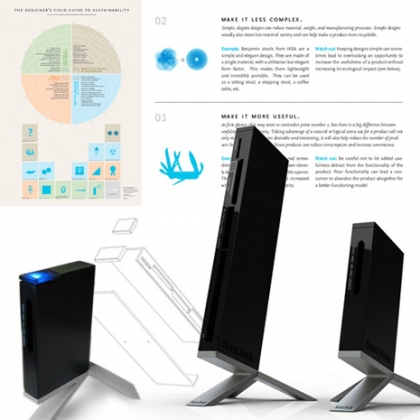
Employing the virtues outlined in LUNAR’s “Designers Field Guide” we identified 15 discreet activities in the design and engineering process. A LUNAR Elements Case Study of the next generation of Sandisk ImageMate card-readers helps illustrate our typical approach to best environmental practices. Here are some of our favorites (please feel free to reference the Designer’s Field Guide to Sustainability document for a more complete analysis):

1. Question the premise of the design. LUNAR began the ideation phase by deconstructing the intent of the product, ultimately arriving at the simplified architecture as a metaphor for reducing the esthetic and physical complexity of a highly visible desktop computer component. We reduced total part count to four!

5. Avoid toxic or harmful materials and chemicals. We eliminated paint on the plastic enclosures in favor of molded-in color. We also eliminated the need for an extra process to apply the logo by molding it into the plastic enclosures. We finished the zinc base with a bead-blast in lieu of the highly common chrome finish.

6. Reduce size and weight. LUNAR minimized the enclosure volume and made the product as thin and light as possible by revisiting the internal layout and conceptualizing a better architecture.

12. Make it modular. The base of the product is modular and it can be used for multiple products in the ImageMate line.

13. Use recyclable materials. ABS enclosures are recyclable, and all the parts can be separated for ease of material disposal.

14. Minimize fasteners. No fasteners are used in these products. The plastic enclosures are ultrasonically welded and the rest of the parts (magnets, label and rubber feet) are glued.

15. Do not use paint. Paint was not required for any of the plastic components.

The Elements Case Study process highlights some of the decisions that were made during each product’s development in an effort to better understand those initiatives that have can have a positive environmental effect. If even an incremental difference, the result for LUNAR is a thoughtfully conceived, more gorgeous product language that exudes our own values and beliefs.

Please visit Sandisk.com for more info on the LUNAR- designed ImageMate family.

Comments

Post new comment

The content of this field is kept private and will not be shown publicly.
  • Web page addresses and e-mail addresses turn into links automatically.
  • Lines and paragraphs break automatically.

More information about formatting options

Top of mind

  • Technology and The Environment Sessions at the International Consumer Electronics Show hone in on some of the most important steps forward the CE industry has taken, from Energy Star advances to best practices in recycling and energy consumption. Las Vegas, Nevada, January 8-11, 2009

  •  Eco-designers are invited to submit their consumer electronics innovations for prizes and recognition at the Greener Gadget Conference, where industry luminaries meet to discuss the future of CE sustainability. Entry deadline is January 15, 2009. Conference will be held in New York, NY, February 27, 2009.

  • Americana International combines a conference program, trade show and international business matchmaking forum among environmental industries that include municipal and industrial wastewater, soil remediation and groundwater, ecoengineering, bioeconomy and life cycle analysis. Montreal, Canada, March 17-19, 2009.

  • Ethical Sourcing Forum North America 2009 spotlights sustainable business practices currently transforming global supply chains. Topics include sustainable purchasing, food, agriculture, and beverage sector, environmental measurement and monitoring and supply chain rating/reporting. New York City, March 26-27, 2009.

  • The Green Business Certification Workshop provides seminars on green marketing, developing partnerships and greening your operations. Participants receive Clean Air Green Business Certification from the Clean Air Institute. Ft. Collins, CO, January 30 – February 1, 2009.

  • The Green Travel Summit convenes a forum for corporate travel, meetings and incentive professionals, and progressive travel service providers to discuss the risks and rewards of building a sustainable travel and meetings strategy. Newport, CA, March 22, 2009.

  • The 8th International Electronics Recycling Congress offers a platform for government, business and academic participants to discuss how manufacturers can close the recycling loop. Salzburg, Austria, January 21-23, 2009.

  • 2009 Good Jobs, Green Jobs National Conference will forge an agenda for creating jobs and new technologies to reduce global warming, increase our energy independence and promote a healthful environment. This year's conference will also include a Green Jobs Expo. Washington DC, February 4, 2009.

  • Best marketing for sustainable energy will be awarded at the World Sustainable Energy Days 2009 conference, 25 – 27 February 2009, Wels/Upper Austria. Deadline for submission is 15 January 2009.

  • World Critical Resources Summit brings together 300 world leaders to facilitate solutions to sustain, expand, and protect the world's critical resources, including shelter, water, food, energy, medicine, and children. January 5th, 2009, New York.

  • A Greener Europe. The European Commission proposed a legislative package last month aimed at improving the environmental performance and energy efficiency of products and stimulating their market uptake.

  • Greener Chrysler Plant Expansion. From recycled paint sludge to replanted prairie grass, Chrysler incorporates environmentally friendly features in a Detroit plant.

  • High Tech, Low Marks. Global executives are concerned about climate change, but they aren't taking action in the supply chain that could address the issue and reduce costs, according to a McKinsey & Co report.

  • The Designer’s Field Guide to Sustainability, by our blog contributor Travis Lee, offers practical suggestions for incorporating sustainable thinking in everyday design.

  • Simplicity Saves the Day: BNN speaks with Paul Polak, founder, International Development Enterprises (IDE), a new for-profit company D-Rev, and author of Out of Poverty.

  • Carbon dioxide produced by the high-tech industry is expected to triple by 2020. Here’s how companies like Google, Cisco, HP, Sun, Intel and Microsoft are working to reduce global emissions.

  • A growing movement among designers, engineers, students and professors and architects is exploring designing and developing low-cost solutions for the 'other 90%'.

  • A new milk jug is green in almost every way – except consumers don’t like it. Here's how the manufacturer is educating consumers to change their perception.

Creative Commons License